
This page provides a quick guide to help you find and access the lovely BET Woodland Reserves.
A full guide and accompanying map can be downloaded from the BET Publications menu: Maps and Guides
Where are the Reserves?
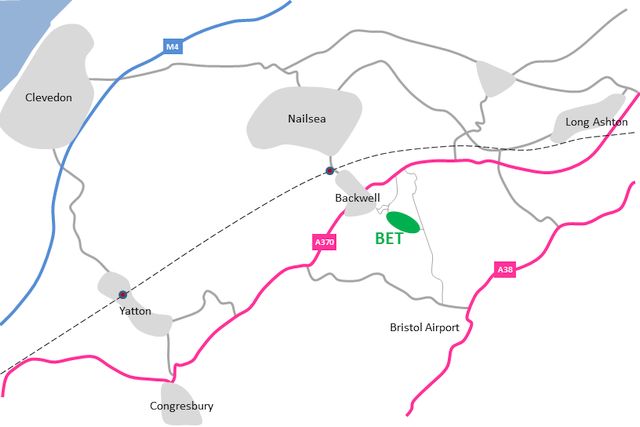
The two reserves lie on either side of Cheston Combe Road on the hillside above Backwell, seven miles southwest of Bristol. The closest post codes are BS48 3JQ and BS48 BS48 3EJ.
The What3Words reference for the Jubilee Stone itself is ///countries.misfits.trend
Parking

Parking space is generally available in Church Town and gives access to the lower parts of Jubilee Stone Wood and Badgers Wood.
Badgers Wood has off-road space for one car half way up Cheston Combe Road on the right. Otherwise people do park on the upper sections of Cheston Combe Road opposite the houses, although care will need to be taken to park sensitively.
Note that, unfortunately, from July 2022 the disabled car parking spaces at the top of Jubilee Stone Wood are no longer available.
Footpaths
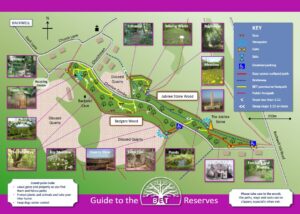
Both Jubilee Stone Wood and Badgers Wood Nature Reserves have many footpaths and trails that can be used to explore the woodlands.
Please take care when walking in the woods as the paths and steps can be slippery, especially when wet.
Jubilee Stone Wood has a public bridleway running the entire length of the reserve, a 300 metre wheelchair-friendly permissive path as well as some minor trails to get you off the beaten track.
Badgers Wood has a public footpath running the entire length of the reserve, a 100 metre wheelchair-friendly path as well as many other trails located throughout the woodland. These include:
- the gentle ‘Community Trail’, close to Church Town
- he wonderful but steeper ‘Fern Way’ – which is described in this article: The Fern Way
- the dramatic and steep ‘Geology Trail’ – which is described here: The Geology Trail
A detailed map of the paths can be downloaded here: Maps and Guides
Wheelchair-Friendly Trails

BET is keen to be as inclusive as possible and has included some provision for people who are less mobile.
Both Jubilee Stone Wood and Badgers Wood Nature Reserves have flat, secure trails that are suitable for everyone.
Jubilee Stone Wood has a 300 metre woodland trail to the fantastic viewpoint at the historic Jubilee Stone. Unfortunately off-road disabled parking is no longer available. Access is now through the bridleway gate.
Badgers Wood has a 100 metre woodland trail to another stunning viewpoint over looking the old Coles Quarry, the Bristol Channel and the Welsh hills beyond. At the start of the trail, off Cheston Combe Road, there is parking for one car.
The aerial map below shows the locations of both trails and the Badgers Wood car parking area.
Ticks and Lyme Disease
Please be aware that there are ticks present in the BET woodlands, so it is sensible to take appropriate precautions to avoid being bitten.
Ticks are tiny spider-like creatures found in woodlands, heaths, parks and gardens throughout the UK, Europe and North America. They feed on the blood of birds and mammals, including humans, and some carry the bacteria responsible for Lyme disease.
Lyme disease, or Lyme borreliosis, is a bacterial infection spread to humans by infected ticks. Lyme disease can often be treated effectively if it’s detected early on. But if it’s not treated or treatment is delayed, there’s a risk you could develop severe and long-lasting symptoms.
The best way to prevent the condition is to be aware of the risks when you visit areas where ticks are found and to take sensible precautions. You can reduce the risk of infection by:
- keeping to footpaths and avoiding long grass when out walking
- wearing appropriate clothing in tick-infested areas (a long-sleeved shirt and trousers tucked into your socks)
- wearing light-coloured fabrics that may help you spot a tick on your clothes
- using insect repellent on exposed skin
- inspecting your skin for ticks, particularly at the end of the day, including your head, neck and skin folds (armpits, groin, and waistband)
- checking your children’s head and neck areas, including their scalp
- making sure ticks are not brought home on your clothes
- checking that pets do not bring ticks into your home in their fur
If you do find a tick on your skin it is important to follow the correct procedures for its safe and complete removal.
For further information and advice, please refer to the following websites: