BET’s Big Wildlife Event – June 2015
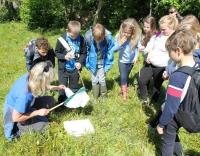
BET’s family wildlife event and Bioblitz to celebrate our first ten years was a fantastic success and enjoyed by over 200 visitors!
…20 years of conservation, protection, improvement..

BET’s Big Wildlife Event – June 2015
BET’s family wildlife event and Bioblitz to celebrate our first ten years was a fantastic success and enjoyed by over 200 visitors!
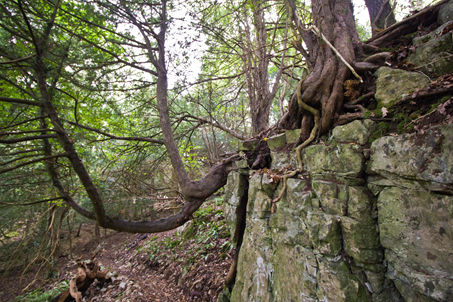
I am fascinated by BET’s magnificent yew trees – they are so atmospheric, dark and moody. It also amazes me how these impressively large old trees can sprout out of seemingly solid limestone cliffs. Whilst working amongst the yews along the new Geology Trail, I thought I would do some digging!
I came across the website of the Ancient Yew Group (AYG) which has a mass of fascinating facts about yews. Of particular interest is that, in 2005 and 2011, Tim Hills of the AYG surveyed Somerset woods, including BET’s, and made special note of three yew trees in Badgers Wood and one on the other side of Cheston Coombe, in Jubilee Stone Wood. The largest of these has a girth of 16 feet and is estimated by AYG to be around 600 years old! Impressive indeed, but not nearly as old as the Fortingall Yew in Perthshire, and one in St Cynog’s in Powys, which are believed to be over 5,000 years old, and may be the oldest living organisms in Britain.
 Yew trees are very difficult to age. Even if one can count the rings, they can have dormant spells when they stop growing for a while and then restart! Additionally, older trees often develop hollow trunks.
Being slow growing, the wood is very hard and dense. It has beautiful colours ranging from the creamy sapwood to orange and purple heartwood. This makes it very special for wood turning, carving and furniture making.
Traditionally yew was used to make English longbows. The sapwood of the yew is good in tension and the heartwood in compression. The best ‘selfbows’ were shaped from a single length of yew, using part sapwood and part heartwood, for the back and belly respectively.

Straight lengths from the yew trunk were needed and once English stocks of yew were depleted, longbow staves were imported from Europe – Spain and Italy in particular. In Tudor times, to ensure a regular supply of fine-grained yew, each ton of certain imports, including wine, had to be accompanied by 10 yew staves.
Yew was actually used for bows in Neolithic times. The Meare Heath bow, discovered in the peat of the Somerset Levels, dates from 2,600 BC.
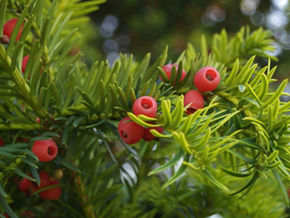
All parts of the English Yew (Taxus Baccata) are highly poisonous, with the exception of the flesh of the red berries (or more correctly arils) of the female tree.
In the 1960s, it was discovered that the poisonous taxane alkaloids in yew could be used in the production of cancer treatment drugs, such as Taxol.
In British folklore, yew is associated with immortality and death. Yew is well known for its association with places of burial and is a feature of many churchyards, often pre-dating the church. Many ancient yews are in close proximity to standing stones, stone circles, and pre-Christian burial sites. There was a pagan belief that the roots of the yew, being very fine, would grow through the eyes of the dead to prevent them seeing their way back to the world of the living. In more recent times, it became a custom for evergreen yew branches to be carried on Palm Sunday and at funerals, as emblems of the resurrection.
All this still leaves me uncertain of the actual origin of BET’s yew trees! But, having such great age and majesty, we must admire and continue to look after our wonderful veteran yews, for generations to come. To quote from William Wordsworth’s poem, Yew Trees:
Of vast circumference and gloom profound
This solitary Tree! – a living thing
Produced too slowly ever to decay;
Of form and aspect too magnificent
To be destroyed.
Peter Speight
Winter Walk – February 2015
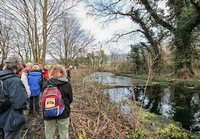
On 15th February, Bill Charnock led 20 BET Members on a ramble from Backwell Woods to National Trust Tyntesfield.
The route headed down to the Land Yeo, passing by Watercress Farm and onto the Victorian Bathing Pond which was constructed around 1890 and is 5 feet deep at one end. After climbing up to Tyntesfield, the group had a rest for lunch and then bodgers Peter and Ted gave an overview of Windsor chairmaking at the bodgers barn.
The path down to Wraxall and Backwell Common was exceedingly muddy but the intrepid walkers survived and agreed the outing had been most enjoyable and informative.
{loadposition WOWTyntes}
Peter Speight
On Sunday 22nd October, BET Members joined in celebrating the completion of two big projects by our volunteers over the past two years.
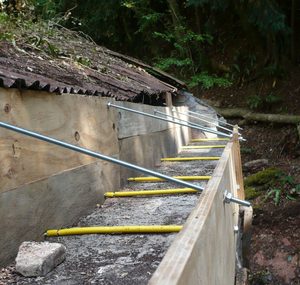
To start with, 25 Members and friends walked along the newly constructed Geology Trail in Badgers Wood. This path was built above the Fern Way with the aim of giving visitors access to the upper slopes and dramatic limestone cliffs along the ridge above Cheston Combe. Tricky sections of the steep terrain had presented some significant engineering challenges for our volunteers, but well-camouflaged ironwork and buttresses have resulted in an exciting yet safe walk through the woods. Everyone enjoyed the excursion and the information provided by BET trustees and local geologist Richard Kefford. Richard is a member of the Avon RIGS Group, and talked about the formation and evolution of the limestone landscape and crags and other features.
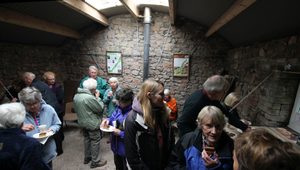
Gradually we made our way down to the newly refurbished BET Cabin to enjoy ample tea and cakes! A total of 35 people admired the amazing transformation which has been achieved by some very dedicated and skilled volunteers. The result is a dry, light and roomy base for BET events like this one. Photos of BET’s work and a display of Richard’s fossils helped to make a very informative and enjoyable gathering.
{loadposition WOWCelebs}
Both projects are now very much open for business!
More photos and videos taken during the projects can be found here:
Peter Speight
Archaeology Walk – July 2014
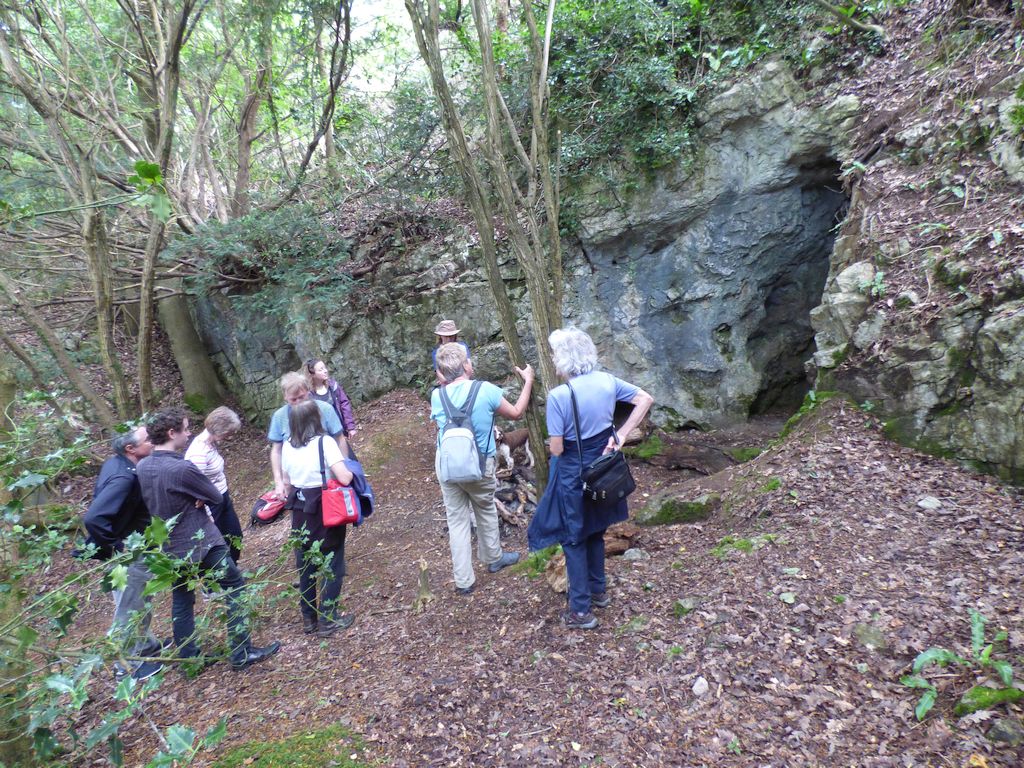
On Sunday 13th July, BET held an Archaeology Walk through its woods, and after meeting by St Andrews Church, our group of 12 interested walkers set off up the ancient holloway path through the Jubilee Stone woods. We paused by the 2 big mounds almost touching each other, which local tradition assumes to be mining mounds, but there are no mine shafts nearby, and their shape is not that of a tip. It is just possible they may be 2 intact Bronze Age barrows, similar to the 4 higher up on the hillside, which have almost been ploughed away.
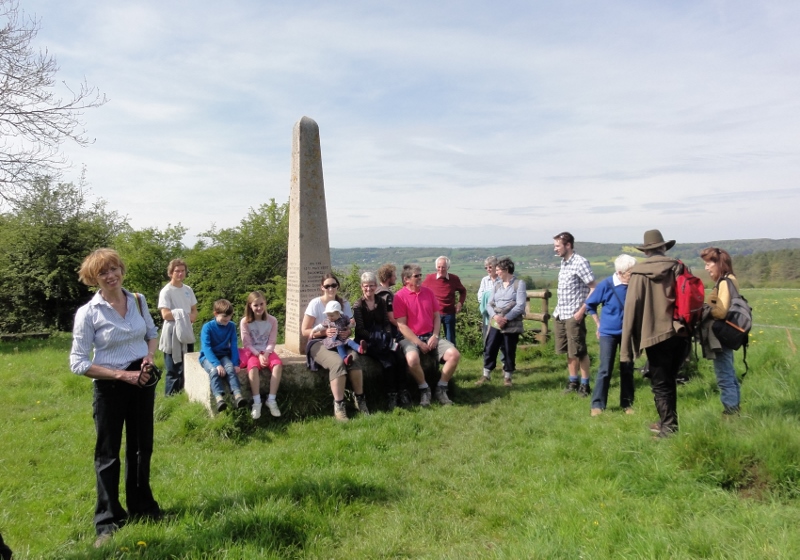
We then walked up the path to the Jubilee Stone, a large granite obelisk built in 1897 to commemorate Queen Victoria’s Diamond Jubilee, which is surrounded by a small meadow of long grasses and wild flowers, and was alive with colourful butterflies. Once over the stile, there in the field were the 4 barrows, possibly up to 4,000 years old, though they are barely visible, apart from the largest one 30 feet in diameter, which was described by Reverend George Masters of Flax Bourton in 1898 as ‘… a cup or basin inverted in its saucer’. He dug into it looking for grave goods (treasure!), but all he found was a pavement of flat stones 2 feet down, covering modern (19th century) pottery sherds, clay pipes and animal bones, which he called ‘a puzzle’.
After admiring the views across the valley, we moved on to the Warrener’s Cottage, lived in until 1843, the Warrener being an important person who looked after the ‘pillow mounds’ or ‘rabbit bury’ – low grassy mounds from 25 feet to several hundred feet long, and between 6 and 20 feet wide – where rabbits were bred, for both food and fur. He also kept predators like stoats, and badgers away, and the inevitable poachers who were always around. All that remains of the Cottage now are low foundations of stone and soil, and tumbled-down outbuildings, whereas the next site we visited – BET’s limekiln, has been excavated and mostly restored.
Small limekilns were once an essential part of life, used to convert limestone (calcium carbonate) into quicklime (calcium oxide), this one being built between 1843 and 1884, the internal part being lined with Nailsea pennant sandstone. Limekilns were so important because from them was produced lime mortar used in building, whitewash/limewash waterproofing paint for houses and barns, and it was also spread on the fields as slaked lime which not only helped ‘sweeten’ acid soils, but also enabled better crops to grow. They were not so good for tramps, however, as many were suffocated by noxious fumes when they sought a warm place to spend the night. BET’s limekiln went out of use between 1884 and 1902.
Then we crossed Cheston Combe road to our lookout point in Badgers Wood to pause for a very welcome cup of tea/coffee and biscuits, and admired the spectacular views across the Estuary towards distant Wales.
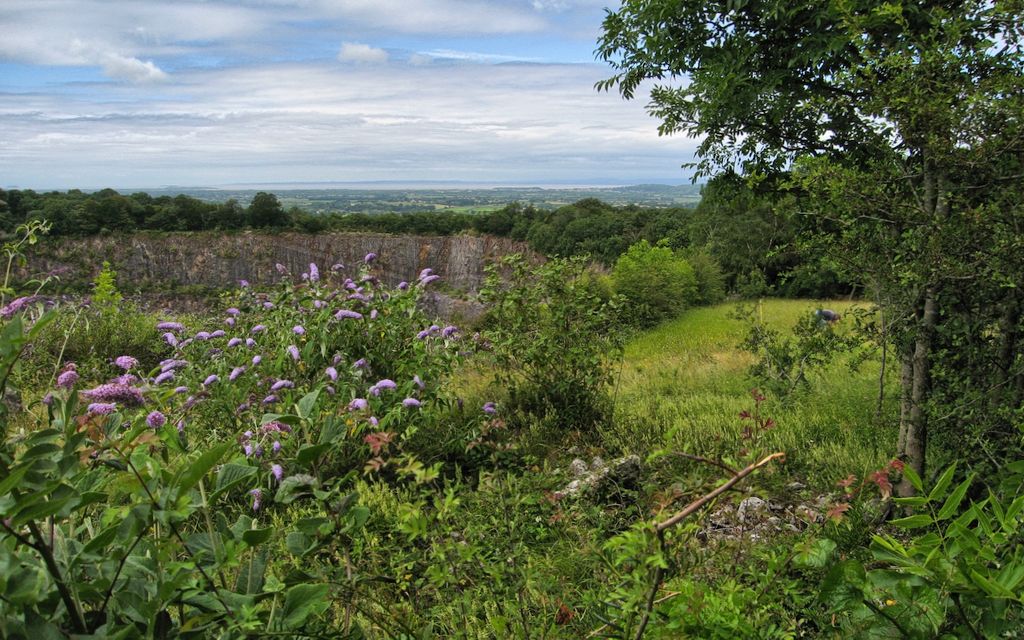
Much refreshed, we made our way down the path towards the Burial Cave at the bottom of the hill. In ancient times a stream flowed over the calcite-covered rock surface of the Cave, giving it an almost mysterious appearance, hence it was thought of as a sacred site.
Back in 1936, when human bones were found by quarrymen digging it out (for calcite for spreading on paths), Professor Tratman excavated what was left, and believed there were 18-30 people buried there, including 3 children. Two skulls were found including one with a large depressed fracture, maybe caused by an axe, and several jawbones still with teeth. Although most of the bones were lost when the University of Bristol Spelaeological Society Museum was bombed in the War, radio carbon dating on 2 vertebrae shows they are 5,000 years old from the Neolithic period, much older than previously thought.
For photographs and more information about the finds, please see this BET article: Backwell Cave
This was the last place we visited on our walk, and then slowly made our way back down to the Church, very pleased that everyone said they had enjoyed themselves, and learned more about Backwell’s archaeology, and the people who had lived, worked and been buried on the hillside all those years ago.
Jenny Greenslade
Spring Walk – May 2014
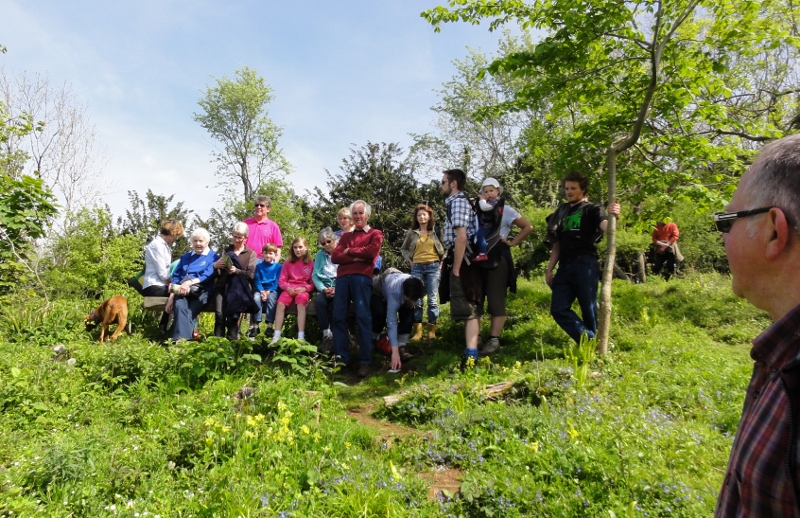
On the wonderfully sunny Sunday afternoon of the Spring Bank Holiday weekend, BET held a guided walk through the woodland reserves, enjoying the fine views and spectacular wildflowers.
Over 20 members and friends of BET enjoyed a gentle walk through the woods and admired the spring flowers at their very best. The walk started at St Andrews Church and headed along Church Town and into Badgers Wood, passing fantastic colourful swathes of bluebells, wild garlic and cowslips before climbing up to the magnificent flower-covered ‘Layers’ viewpoint (above).
The group walked up the Fern Way, past the old oak tree, and stopped to take in the impressive view across the old quarry before crossing over Cheston Combe to the Jubilee Stone (below). They then headed down the bridleway taking in more bluebells on the lower loop path.
Refreshments back at Church Town were well earned and much enjoyed by all. Thanks to Amanda Swannell for organising a great afternoon!
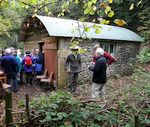
The Cabin Restoration
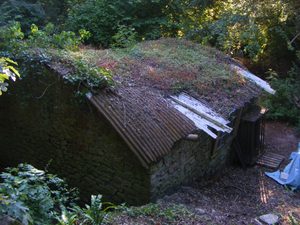
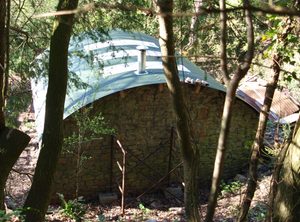
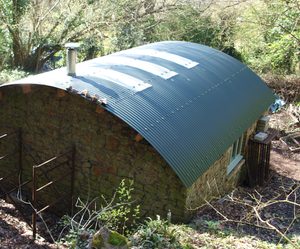
When we purchased our second woodland reserve in 2009 – Badgers Wood – BET acquired a semi-derelict building. This was once a garage belonging to Quarry House and was used to house the Rolls-Royce! By 2012 the garage was in a very sorry state, with the roof in imminent danger of collapse, despite being propped up by ash tree trunks. It was decided that, to save the building, urgent repair work was needed to strengthen the side walls, build a supporting front wall and replace the roof structure.
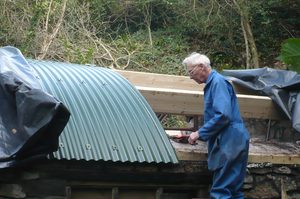
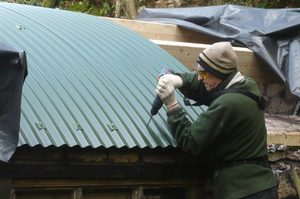
This was more easily said than done – but we are incredibly fortunate to have some very skilled and dedicated volunteers who have been working tirelessly to complete a dramatic restoration. Their hard work has included digging foundations, building a 10-foot high block wall, laying concrete and steel reinforcement along the tops of the side walls, cutting and drilling stone, welding door frames – and carefully aligning the 5 new laminated roof beams before fitting 27 curved sheets of corrugated steel.
What an achievement! You can see the fun the guys had with the roof, in Andy’s timelapse video:
In addition, overhanging trees were removed, tons of soil and other debris excavated from around the outside, and repointing of the stonework carried out. Brilliant new windows have also been supplied and fitted – all free of charge – thanks to the generosity of Brorn Windows of Congresbury. http://www.brornwindows.co.uk/
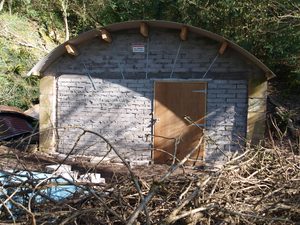
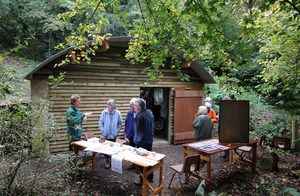
The transformation has been amazing and now, in October 2014, is complete, with new doors and the front cladding back in place. The refurbished BET Cabin will be a great base and shelter for our volunteers and participants on our events, and should now last for many more decades.
Here are some impressive before and after photos – plus pictures of the opening event and BET Members celebrating a fantastic achievement!
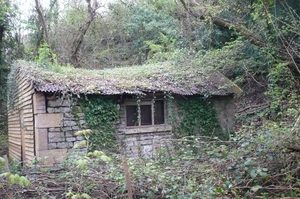
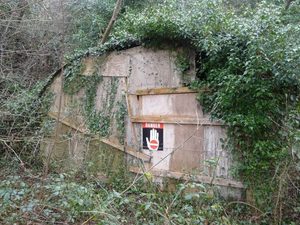
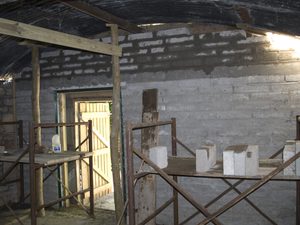
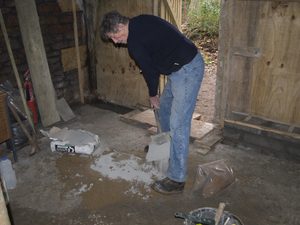
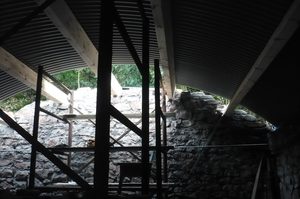

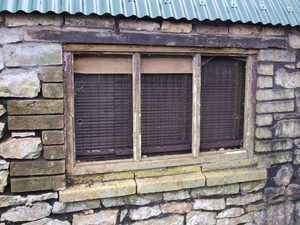
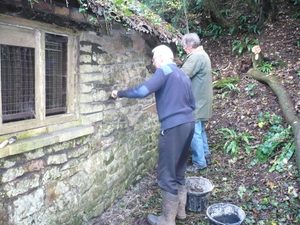
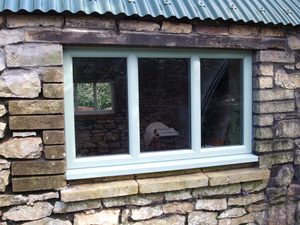
Enormous thanks are owed to the core team of Gerry, Andy, Don and Tony. BET would also like to thank neighbouring members David and Jean Glasson for their great support throughout the project, use of their driveway and water supply!
Events and Activities in the coming months
The Backwell Environment Trust organises several events each year aimed at encouraging visitors of all ages to come and enjoy different aspects of our beautiful woodland reserves. These events have typically included themed walks or hands-on learning experiences.
Keep an eye on this section for information on future events, once confirmed. We hope you will come and enjoy these with us!
Click on the Events menu item “Past Events” to read about some of the fantastic events we have run previously.
|
Future Events 2025 |
|
Saturday 11 November – 20th Annual General Meeting BET’s 20th AGM will be held in Backwell Parish Hall, starting at 2pm. After the formal business proceedings there will be a break for tea, coffee and cake. After tea BET Trustees will look back at BET’s history and achievements over the past 20 years. Minutes of the 19th AGM can be found here: BET AGM |
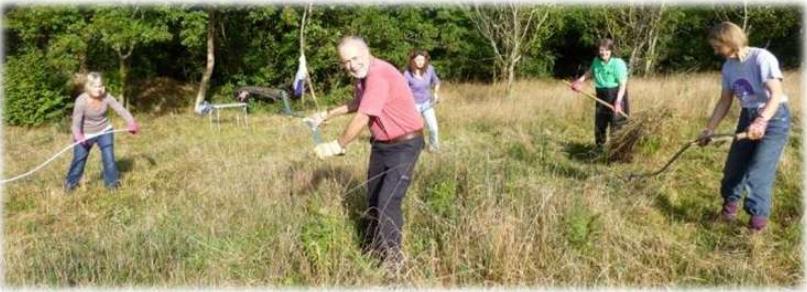
There many reasons why I turn up for a couple of hours whenever I can on a Monday morning to help with the array of tasks that BET volunteers undertake. But I’ll try to keep it brief!
The first point is that it’s really worthwhile. We have all had formative wildlife experiences. Mine came when I was out for a walk when I was about 6 years old and saw what must have been a grass snake at the edge of a field in Kent. But there have been many others over the years – ranging from tigers in India to condors in Chile and, equally satisfying, otters near Nailsea. I’m sure you’ll have had many experiences of your own. And of course, we’ve all seen the brilliant BBC Natural History Unit programmes on television. But you don’t need me to tell you of the threats that wildlife faces – it’s a constant battle, and of course we feel pretty powerless individually to do much about the big issues, like ivory poaching and rainforest destruction. But by helping to conserve wildlife locally, we can all make a small contribution.
But it’s not just altruistic. It’s simply great to be out in the fresh air. It certainly beats going in to the office on a Monday morning, as I did for 35 years until I stopped work last year. And it helps you keep fit. I do go to the gym, and pound the streets, for exercise during the week but it’s just as sapping to do a couple of hours scything on the BET reserves – it certainly makes you swing your hips around! And you learn new skills. The scything is one example, but there have been plenty of others: dry-stone walling, coppicing and path-building, for example. And you learn a lot more about nature, what needs doing at what time of year and why; and just identifying things – I never learned much about trees when I was young, so it is really satisfying to improve my knowledge on that front too.
Next there’s the shared satisfaction from being part of a successful team. Several times this year we’ve set about a seemingly daunting task – scything a meadow, clearing ragwort – and found that we’ve managed to do all that we planned, and more, within the time available.
But don’t get the impression that it’s all hard work. It’s actually very sociable, both while we’re working and at the legendary coffee breaks, which have been known to extend for 45 minutes within the allotted two hours. Excellent biscuits invariably turn up (I must remember to bring some myself!), and there is good conversation (not obligatory though – some prefer to keep working!). And finally it doesn’t matter (much) if you make mistakes. Two of us did just that in a fit of enthusiasm in the summer when we removed the wrong type of thistle. I don’t think that the Reserve Manager was exactly pleased but he is very philosophical on the basis that things always grow back….
So, all in all, what is there not to like? If you haven’t come before, do come and join us – a weekly email will tell you when and where. Just let Ian (463315) or Peter (851416) know that you might be interested, and they can add you to the mailing list. And if you can’t make it on a Monday because work or other commitments rule that out, there’s always the fourth Saturday of each month (changed to the third Sat from May 2017), where the same arrangements, and satisfaction levels, apply. Oh, and it doesn’t need to be for the full two hours – I’m notorious for arriving late or leaving early (or both) but the important thing, like the Olympics, is the taking part (though not necessarily every week!).
We look forward to seeing you whenever you can make it!
Martin Brasher
Volunteer and ex-Trustee
Nest Box Survey 2015/2016/2017
Clearing the nest boxes is a bit like a lucky dip – you never quite know what you are going to find. In past years there have been indignant yellow-necked mice, a wasp nest, squirrel nests, a wad of wax moth cocoons, and always a selection of huge spiders, countless woodlice and fat slugs.
We do also find bird nests and dormice nests and, as Gill will attest, fleas! The surprise for 2015/6 was finding that one of the owl boxes was not stuffed with the dead leaves typical of squirrel occupation, but dry green leaves indicating that a dormouse had been in residence.
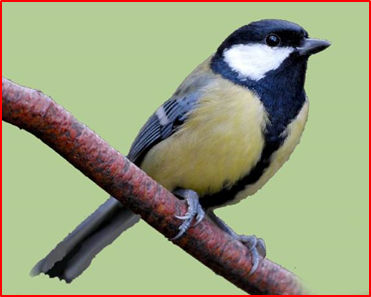
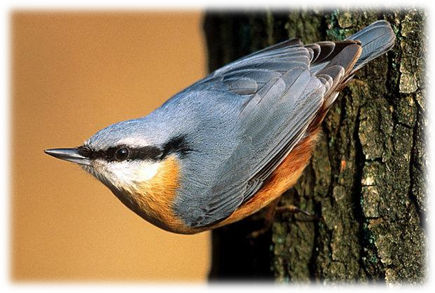
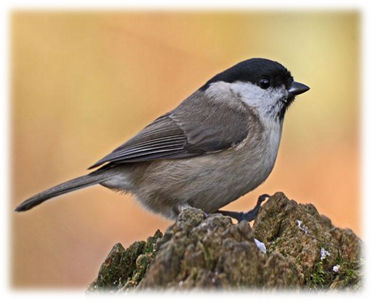
Jubilee Stone Wood has 26 boxes and Badgers Wood 30. In both reserves about 50% had bird nests. On looking inside, what one hopes to see is a nest from which it is evident that all chicks have successfully fledged. Occasionally we find abandoned clutches of eggs, or, sadder still, little skeletons. This year there were 4 obviously failed broods. The usual occupants are great or blue tits, but we did find 2 marshtit nests and one which was most probably that of a nuthatch.
 There are always a few yellow-necked mice, wood mice and dormouse nests. This year there were at least 5 boxes which had both bird and dormouse nests, with a further 3 with just a dormouse nest.
January 2017 update:
Badgers Wood last year – 15 bird nests, 14 no nests, 4/5 dormouse nests; this year – 14 bird nests, 17 no nests, 7 dormouse nests.
Jubilee Stone Wood last year – 13 bird nests, 13 no nests, 4/5 dormouse nests; this year – 11 bird nests, 15 no nests, 2 dormouse nests.
Some boxes have both bird and dormouse nests.