Author: PeterBET

  • Limestone Pavement

    Limestone Pavement

    Amazing geological discovery! BET unearths a rare limestone pavement rock formation in Badgers Wood.

    Whilst reinstating a stretch of little-used public footpath in Badgers Wood in July 2018, volunteers uncovered an unusual limestone rock formation.  Further digging and research showed this to be a “limestone pavement” with its characteristic crevices and gulleys.  A section 5m x 5m was exposed which looks quite dramatic.
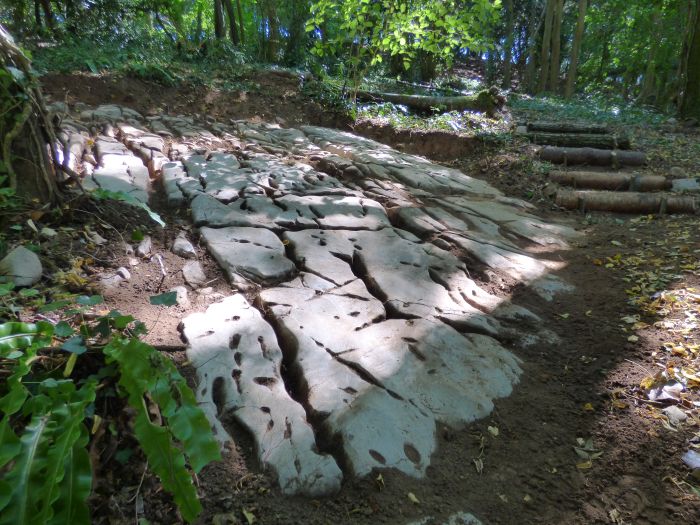
    Limestone Pavement 1 700

    Our focus then moved to another stretch, near the top junction of the Fern Way and the Geology Trail, which showed signs of a similar rock formation.
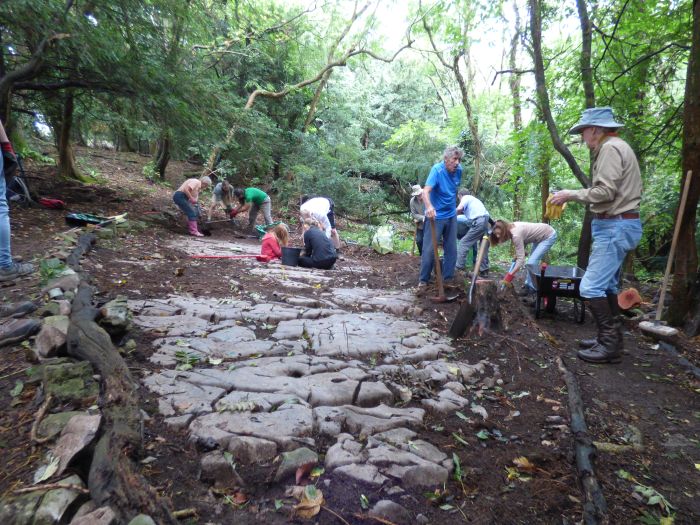
    Limestone Pavement 2 700

    After a lot of hard work, a large area of limestone pavement has been exposed which is a remarkable feature to visit.
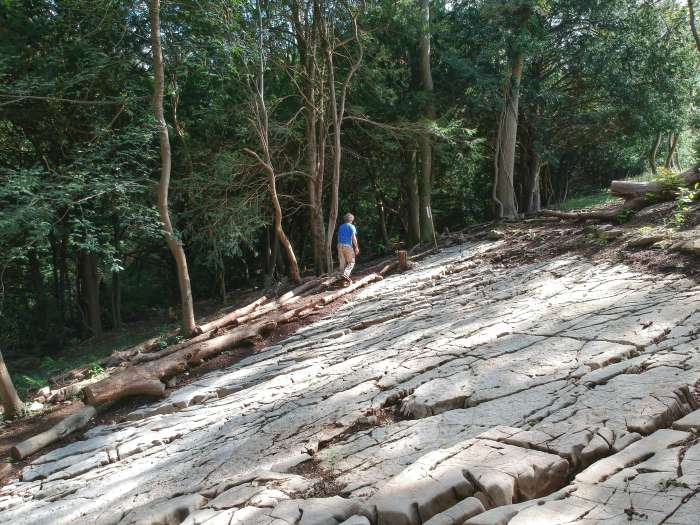
    DJI 4151 HDR 700

     The local RIGS geologist group is really excited by the discovery of this rare limestone pavement and we hope this will lead to further investigation and possibly SSSI status.
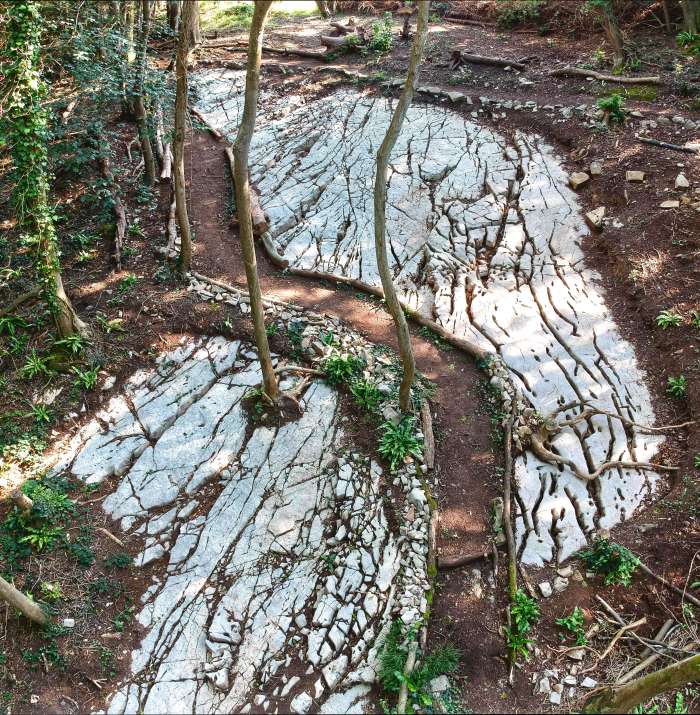
    Pavement aerial 700

    What is a limestone pavement?

    A limestone pavement is a flat expanse of exposed limestone formed by a combination of chemical weathering and erosion. Most limestone pavements in the UK are formed on Carboniferous limestone and whilst there are superb examples in Yorkshire, they are an extremely rare geological feature in the south of England.

    How do limestone pavements form?

    1. During the ice ages, much of Britain was covered by ice sheets and glaciers. During this time, the soil and weaker surface rocks were often scoured away, leaving broad expanses of exposed limestone.
    2. With the retreat of the glaciers, moraine material was left behind and a forest eventually established itself. Mildly acidic rain water percolated through the soil which gradually dissolved the limestone surface.
    3. Under the soil, the rain water picked out the joints in the limestone and gradually widened them by dissolving the rock. This created deep fissures called grykes. The blocks of limestone (or clints) were also attacked by the rain and small holes and gulleys (or karren) formed on their surface.
    4. When the ice finally retreated, the soil on the top of the limestone pavement was eroded, washed down into the grykes and removed altogether by the drainage system. The exposed limestone pavement would have been constantly chemically weathered, resulting in the further widening of the grykes and the karren.
    5. Badgers Wood’s extensive limestone pavement is today buried under 5 – 20cms of soil. Sometime in the last thousand years, decomposing vegetation has accumulated on its surface, slowly turning into soil and has consequently buried the once exposed rock surface.
  • Metal Detecting Finds

    Metal Detecting Finds

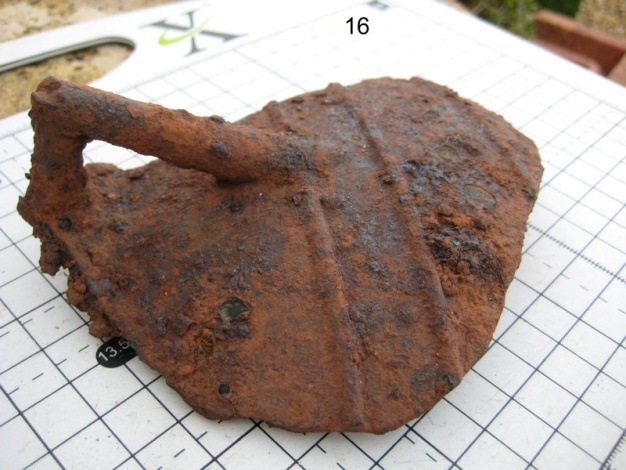
    This two-page article catalogues the various metal objects discovered in the BET Woods by a local metal detectorist, Keith Matthews, CPO RN, Retired.  Some of the items featured in an article in the BET Bulletin, Spring 2014.  More recent finds have been added to the lists, as they have come to light.  

    These finds give us a fascinating glimpse into the history and lives of the local inhabitants.

    This page presents the various coins that have been found whilst a second page shows other interesting artefacts: Metal Detecting Finds (2)


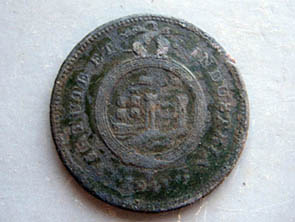
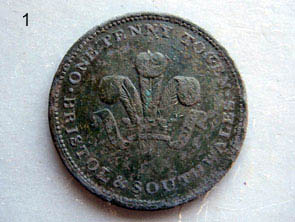
    Bristol & South Wales One Penny Token, dated 1811. Due to a shortage of copper (the Navy was copper bottoming its ships at the time), local associations/ industries produced tokens in place of small change in the early 19th century, like this one for use in specific areas.


    Made by Thomas Halliday of Bristol.


    Die Engraver – Bristol Brass & Copper Co.

    1811 Penny
    1811 Penny rev

    Victorian four pence piece or ‘Britannia Groat’, 1845

    1845 groat 01

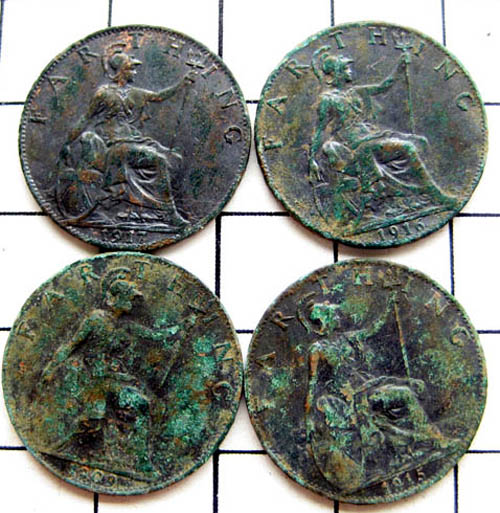
    Four farthings 1909, 1915, 1916, 1917 all found in one hole.  Probably a ‘pocket spill’.

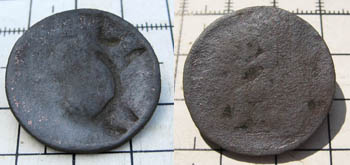
    A George II ha’penny, date unknown.  You can just make out “GIUS” at 10 o’clock and “II” at 1 o’clock.  This is being soaked in olive oil , hopefully to soften the crud.

    George II (1683 – 1760) was  King of Great Britain and Ireland.  He married Caroline of Ansbach in 1705, and was the last British King to fight in battle (in Austrian War of Succession).  He was patron of musicians, including Handel.


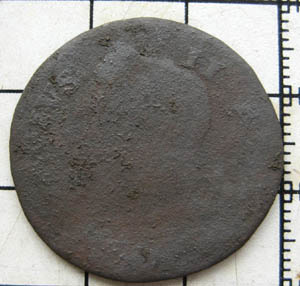
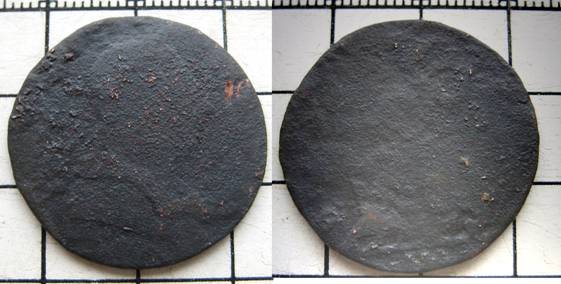
    A George III (1738-1820) ha’penny, in poor condition, with only “GIUS“ (from Georgius) readable. The indistinct bust of himself is facing right, which helps identify it.

    A second battered George III ha’penny is shown underneath.


    George III halfpenny

    Geo III halfpenny 2 copy


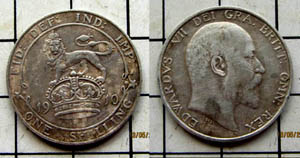
    Edward VII shilling, 1910 – solid silver.

    Edward VII (1841 – 1910) married Alexandra of Denmark in 1863, and later succeeded his mother Queen Victoria as King, upon her death in 1901.

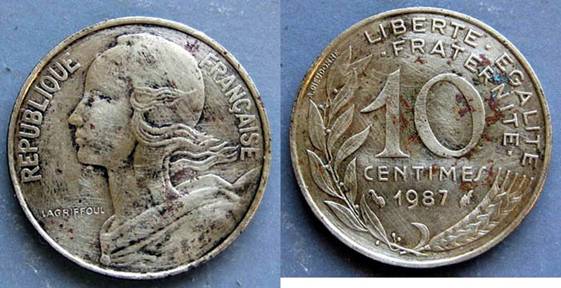
    French 10 centimes of 1987

    10 Centimes

    Click here to see other finds: Metal Detecting Finds (2)


  • 29th April 2024

    29th April 2024

    Monday 29th April 2024  9.15 to 9.50 a.m.

    Lower Jubilee Stone Wood can be accessed by following the bridleway sign on the level part of Church Town road, up from the Church.  The sign points up a short piece of road leading to a particularly steep stony track. As I approach the gate at the top I try not to sound too breathless.

    Happily the sound of birdsong and calls reach me even before the top of the climb.  Blue Tits are flitting between trees and bushes with their multitude of spring time calls, a Robin is singing close by as is a Nuthatch and a Great Tit.  In the woods to the left, a Song Thrush is belting out its morning tune and lambs are baaing in the field beside the wood.  High above in the tall trees are the Jackdaws.  Although Jackdaws generally reside in the quarry by Badgers Wood, they particularly like to spend time hanging out and calling from these Jubilee Stone Wood trees where they have a fantastic vantage point over Backwell.

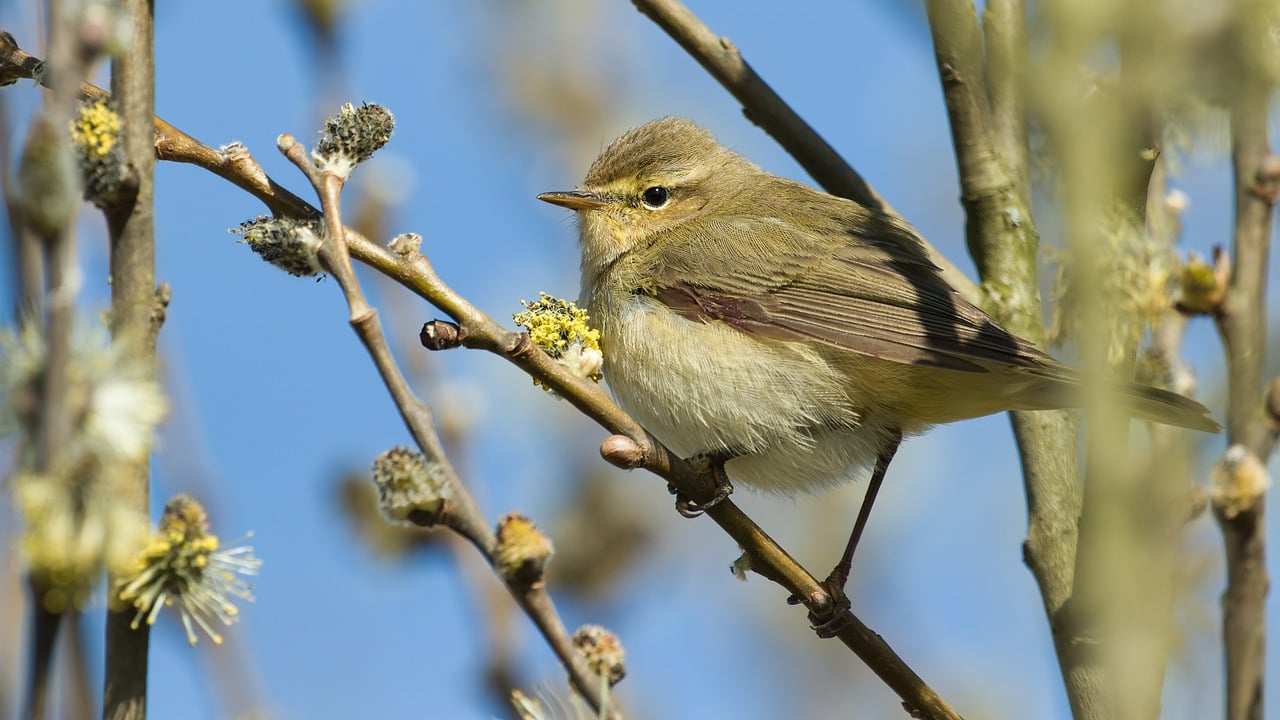
    Up the bridleway through the woods, past the stile on the left, there is a rustic wood bench.  Perfect for sitting, catching the odd glimpse of sunshine and listening.  Chiff Chaffs are in full song now and can be heard in every part of the wood.  Blackbirds, although also in good numbers, are by contrast much quieter.  The females are hardly seen now and as a male Blackbird swoops past me I get the feeling he is very busy on family duties.   Goldfinches pass overhead chattering as they go, I catch a brief song of a Blackcap and then another Robin and then the rasp of a Greenfinch.

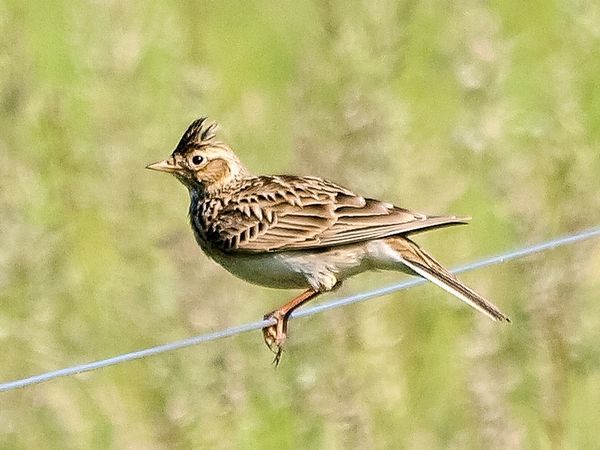
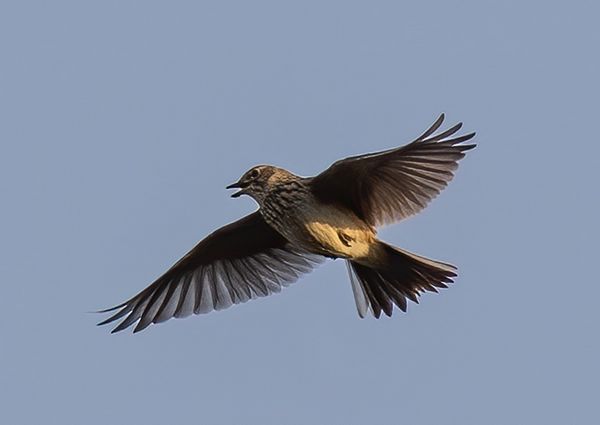
    All of a sudden, as the sunshines briefly, I catch a most unexpected sound.  Listening carefully I can definitely hear the song of a Skylark.  Skylarks have never appeared on our Woodland bird surveys so I pause to listen carefully and realise that although the sound is close, it is coming from the adjacent field.   skylark 1 600

    But what a joy!  Skylarks are, to me, very attractive birds.  On first glance they are small and brown but on closer inspection you can see they are have a pretty speckled chest and brown wing feathers. Their distinguishing feature is their delightful brown streaky head crest which can be raised in alarm. 

    skylark 2 600

    Skylarks are red listed birds which means their numbers have dropped significantly – thought to be because they nest on the ground often in open fields and therefore suffer from disturbance.  However, they persist where they can and their complicated and melodic high-pitched and vertical song flight is one of the joys of spring.
    I sit for a bit longer and note how the the bird sound drops as the clouds roll in.  As I head back down the path and out the woods I am accompanied by the not unusual reverse song of “Chaff Chiff”.


  • Logging action 2024

    Logging action 2024

    Ash dieback 1

    Logging Action Film – 2024

    Another video of BET volunteers shifting logs down the steep slopes of the reserves.  As shown at this year’s AGM.

    The felling of diseased ash trees resulted in a large volume of excess timber on the reserves.  We have left some logs as habitat piles but the majority needed to be removed.  Over the past couple of years, Backwell Logs have partnered with BET to collect the logs and process and dry them for firewood sales.  

    Ash dieback 1

    Our challenge has been to move the heavy logs from the middle of the reserves, down the muddy and rocky slopes, to the roadside for collection.

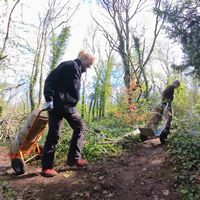
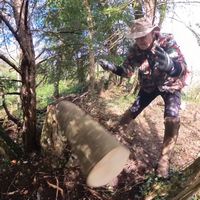
    Last year we enjoyed having heavy horses in Jubilee Stone Wood for a couple of days to extract logs.  This year we had to rely solely on volunteer power and tried to find some more direct routes down the hillside to the road.  Sack trucks proved to be a great new way to move big logs to the top of a slope.  Then gravity played a major part, with ropes being used to drag the logs to stacks near the road.
    Between March and May a staggering number of logs were moved safely down the hill and stacked for collection.


  • Metal Detecting Finds (2)

    Metal Detecting Finds (2)

    This second page catalogues the fascinating collection of non-coin objects discovered in the woods.


    An unusual very large safety pin with traces of gilding.  Possibly a scarf pin.

    Safety Pin

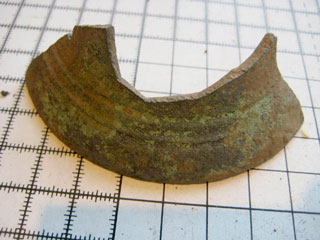
    Section of a bronze bell. Probably post-Medieval and maybe 500/600 years old.

    bronze pot 02

    Part of a cast iron pot or cauldron.  Probably 18th or 19th century.

    Iron Pot Fragment

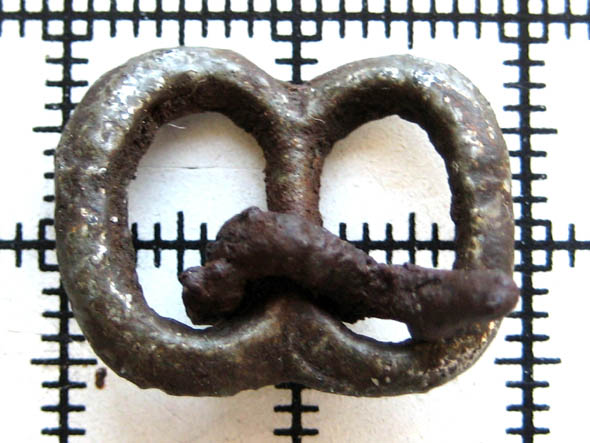
    Buckle from 16th or 17th Century

    Buckle

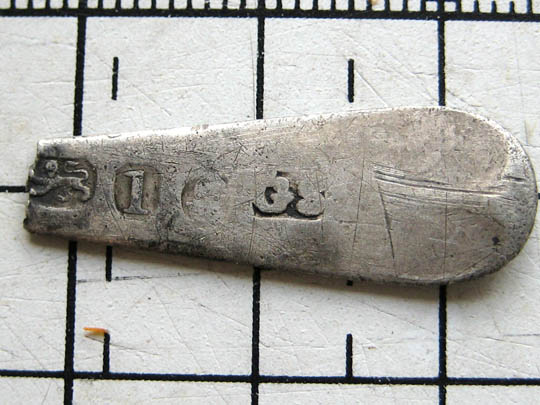
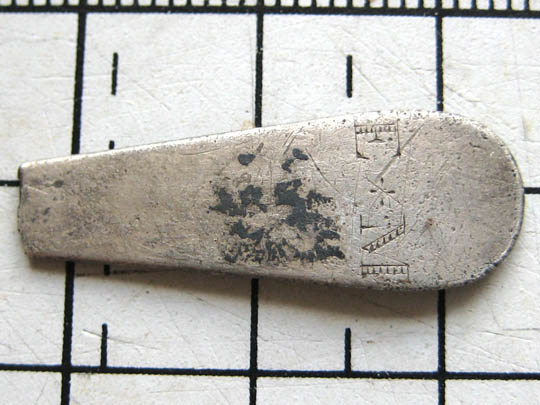
    Silver spoon handle, hallmarked London 1786/7, maker George Smith. The reverse has the initials E M.

    Spoon handle 01

    Spoon handle 02

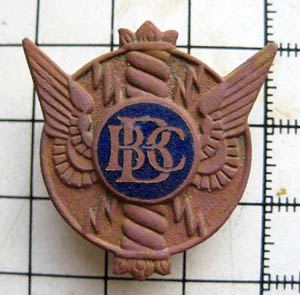
    ​BBC staff lapel badge, worn 1940s – 1960s

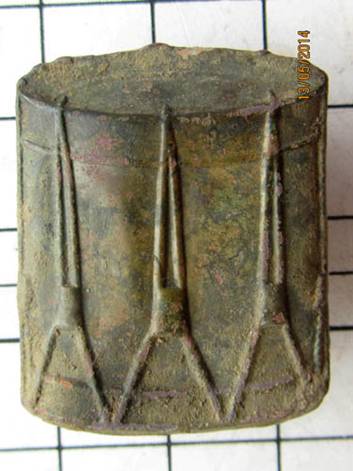
    Drummers badge of unknown type

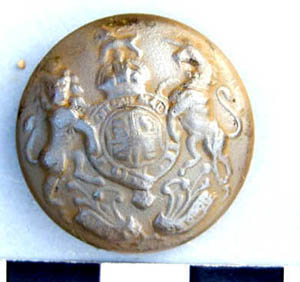
    Army General Service button mid 20th Century.

    Two of these have been found.


    ​Bristol Tramways & Carriage Company Ltd button.

    BTCC became Bristol Omnibus Co in the mid 1950s.

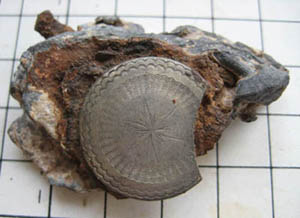
    An 18th Century decorated button firmly embedded in a chunk of lead, with a ferrous material in between.

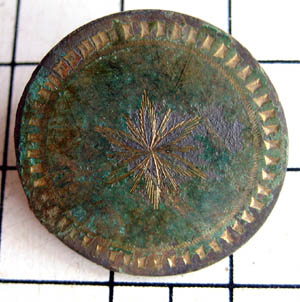
    18th Century decorated button.

    Evidence of heavy industry!
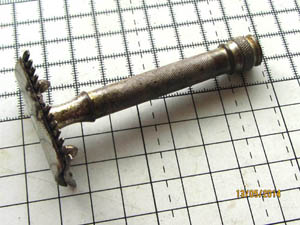
    Razor!
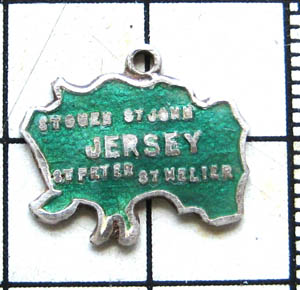
    A souvenir from Jersey!
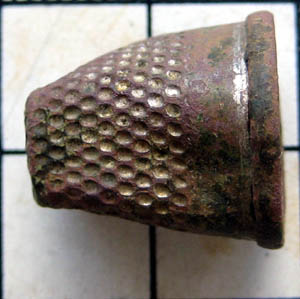
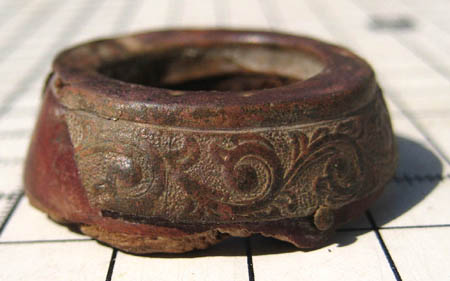
    A child’s thimble – internal diameter approx 10mm.
    As yet unidentifed!  
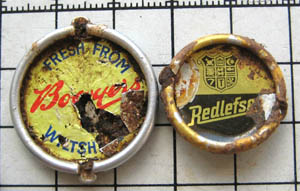
    Pot tops
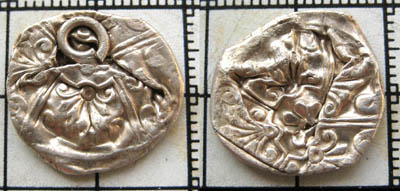
    Possibly a small bell or spherical locket – squashed. Not yet confirmed as silver.
    Squashed
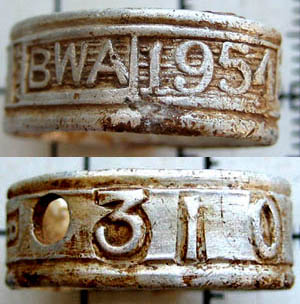
    Bird leg ring confirmed by the British Wildfowl Association as almost certainly off a Barnacle Goose.
    Legring copy

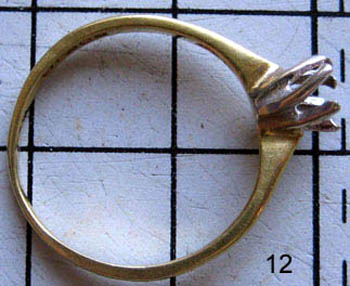
    A gold engagement ring, sans stone, London Assay mark 1977, 19 carat.

    BW Ring  copy

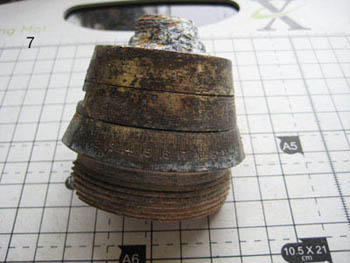
    A time fuse from a WW2 3.7inch AA shell

     
    JSW 3.5in fuse

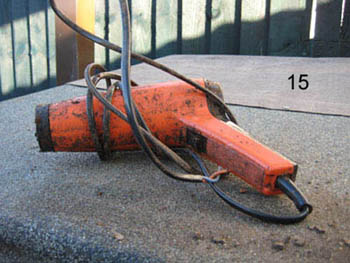
    A hair dryer

     
    BW Hair-Dryer  copy

    Almost a full clip of 9mm pistol ammunition

     
    BW 9mm 18 Apr 14 copy

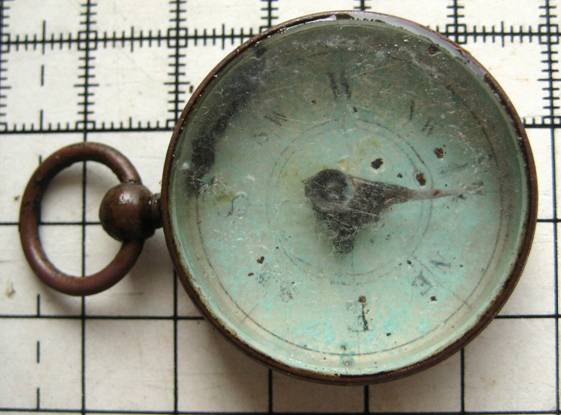
    Compass

     
    Compass

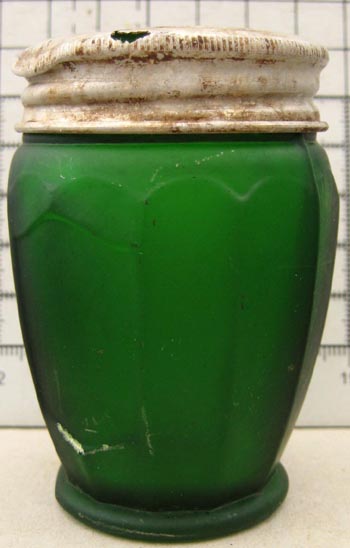
    A cream pot of the Icilma Cosmetic Co. One reference reports their closing down in 1932, whilst another shows them registering trademarks in 1962.

    Apparently, they had definitely closed by 1979. This is probably from 1940s-1950s.

    Cream Pot
     
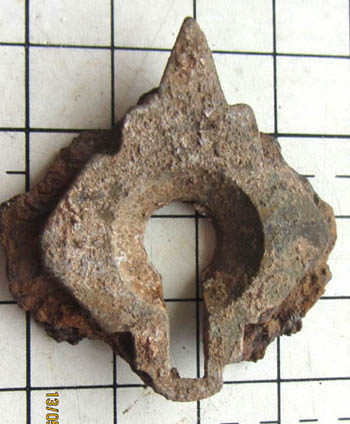
    A keyhole escutcheon plate. The rivets on the back suggest it was attached to a metal container.
    Keyhole BW copy
     

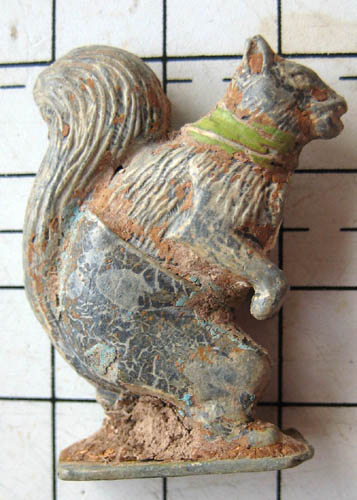
    A Cadbury Britains hollow cast Cococub Nutty Squirrel. Cococubs was a kids club of the 1930s. There were 30+ figures in the range. For further details see:

     http://www.cococubs.com/Cubs_Names/cubs_names.html

    Squirrel Bw 1 copy
     

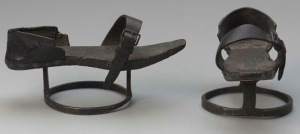
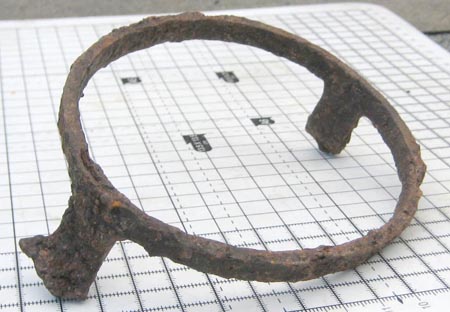
    A “patten”.   Pattens were under-shoes, made from metal or wood and were worn to raise the wearer out of mud or the effluence of city streets. The Worshipful Company of Patten Makers was founded in the 17th Century.  For reference, here is an example of a complete patten:


    Bristol Dairies became part of Cow & Gate around 1968 and later Unigate.
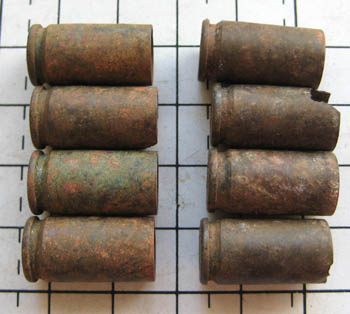
    Shotgun catridges, normally treated by detectorists as scrap. Interestingly, these finds are all different.
    Shotties copy
    An unidentified copper rim from something. The material under the copper appears to be cork.
    Rim
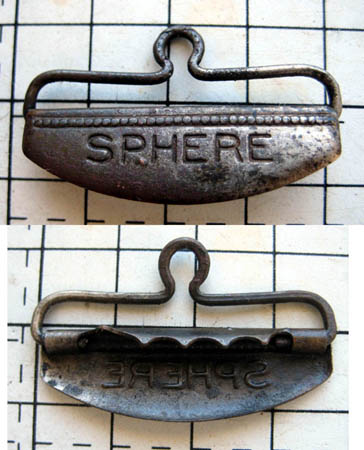
    A clip of some kind.
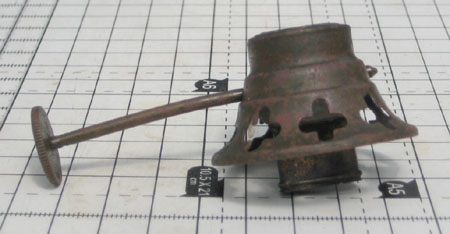
    Oil lamp burner
    Not so old!


  • Late summer

    Late summer

    Late Summer

    Viv looks back at some of the other wildlife highlights during her butterfly and bird surveys this year .

    Early September and already we can feel an autumn chill in the air.  The skies are overcast more often and, with the woods bathed in shadow, we will struggle to do many more butterfly surveys this year.  It was a really difficult spring weather-wise for wildlife and our butterfly surveys are certainly reflecting this.  It is sad to see our butterfly numbers so low and we are just grateful that nearly all regular species have been spotted at least once.  We can only hope for better weather and numbers next year.

    So to bring some cheer to my blog I thought it would be fun to list the alternative highlights of our butterfly surveys this year so here they are:

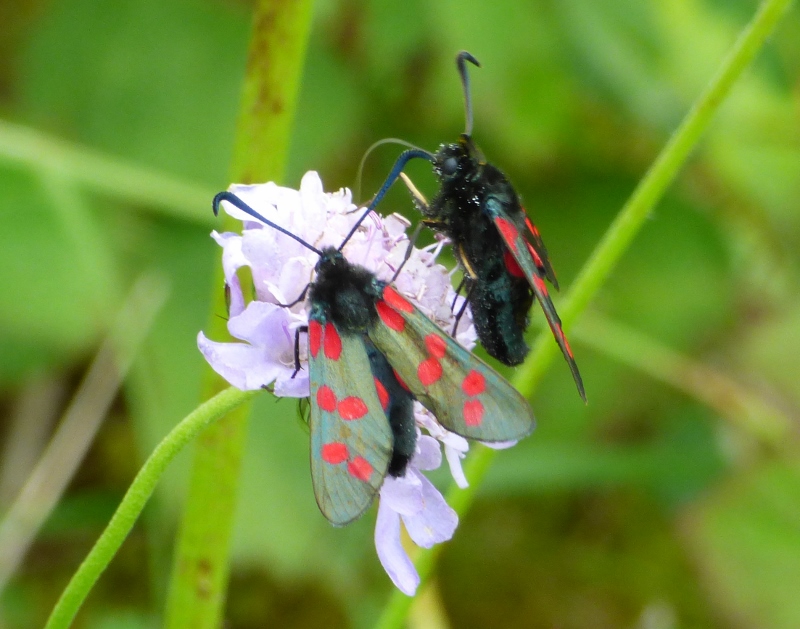
    The Six-spot Burnet moth. Six spot Burnet 2

    What an absolute beauty and so cheering to see so many in the meadows above the gorge. As we scurry around looking for elusive butterflies these wonderful day flying moths buzz around us bringing colour and life.  Their favourite flowers are scabious, thistles and knapweed – which we just happen to have in good numbers!

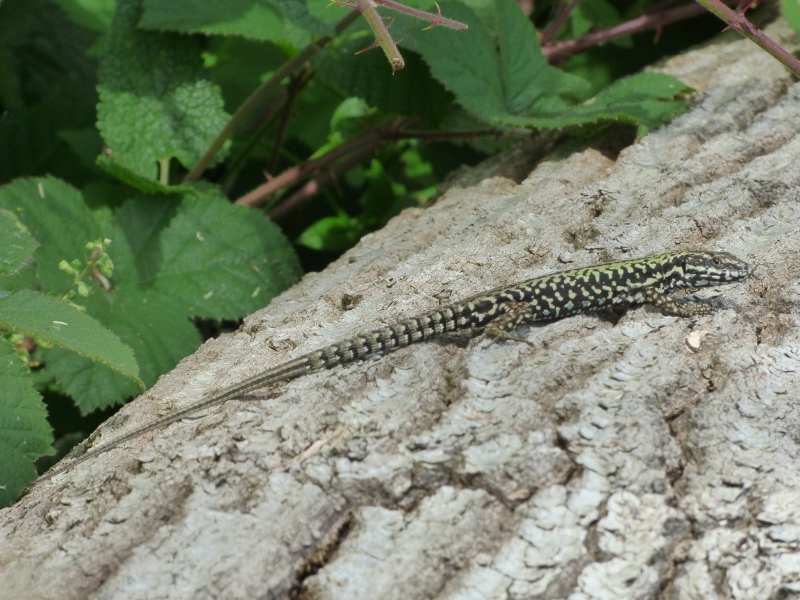
    The Common Wall Lizard. 

    Common Wall LizardWhich actually isn’t that common at all in the U.K. and has fascinated us with its unexpected appearance at the top of Badgers Wood near the quarry. 
    Studying their size and tail length we believe we have identified several and hope they are part of a thriving family.  We look out for them whenever we survey and never fail to be delighted by their speed and agility.

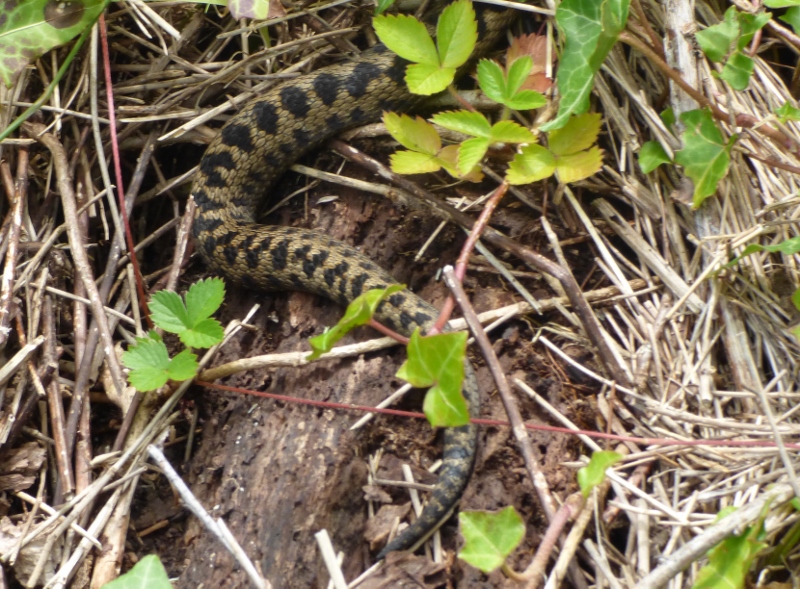
    An Adder.  AdderAdder

    Our trusty butterfly photographer just managed to avoid putting his foot down on this small one.  As the UK’s only venomous snake it’s best to avoid treading on them – although their venom is generally not dangerous to a healthy adult. Instead we enjoyed seeing the incredible markings close up – so distinctive from the Grass Snake which we also have in the woods and see rather more often.   Having reached an impasse with neither snake nor photographer moving, I gently carefully tickled its underside with a long grass and it slithered away quietly.

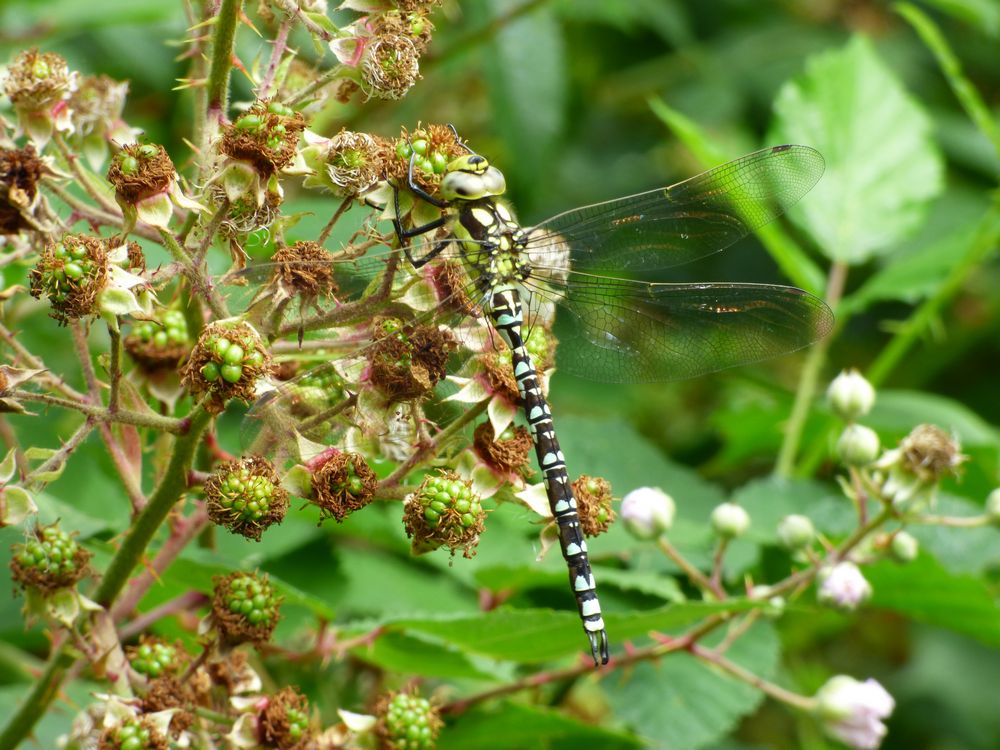
    The Southern Hawker dragonfly.  

    Souhern HawkerOur first year of officially monitoring dragonflies and damselflies on the reserve and I for one have much to learn.  Once they stop for long enough to be photographed I get a chance to enjoy their amazing colours. I have also come to realise how territorial dragonflies are.  Whilst the damselflies are busy doing their own thing and tend to ignore our presence the dragonflies often make a point of making themselves known and asserting their ownership of a particular area we might be passing through.  Dragonfly dive bombing is definitely a thing and when we have impeded their flight path we have had plenty of experience of this over the summer!

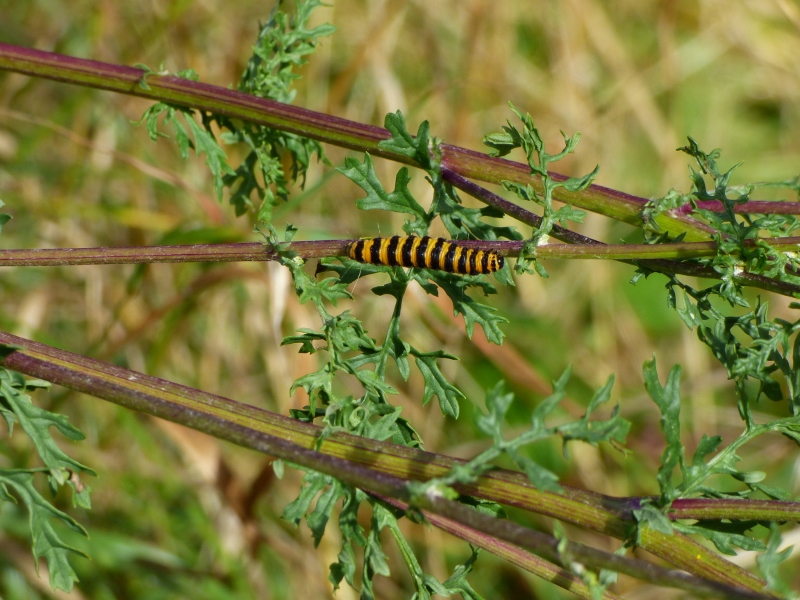
    Cinnabar moth caterpillar.  Cinnnabar moth caterpillar

    These lovely brightly coloured caterpillars are absolutely dependant on munching our Ragwort for their diet and we have been very fortunate to have had a really good crop of Ragwort in the woods this year. The caterpillar colours denote a warning as all their Ragwort munching can lead to them being toxic for predators.   Once the caterpillars have consumed as much as they need they dig themselves into the ground and spend 12 months underground as a pupae before emerging as a beautiful black and red moth not totally dissimilar to the 6 spot burnet.  Fingers crossed we see many of these beautiful moths next summer.   


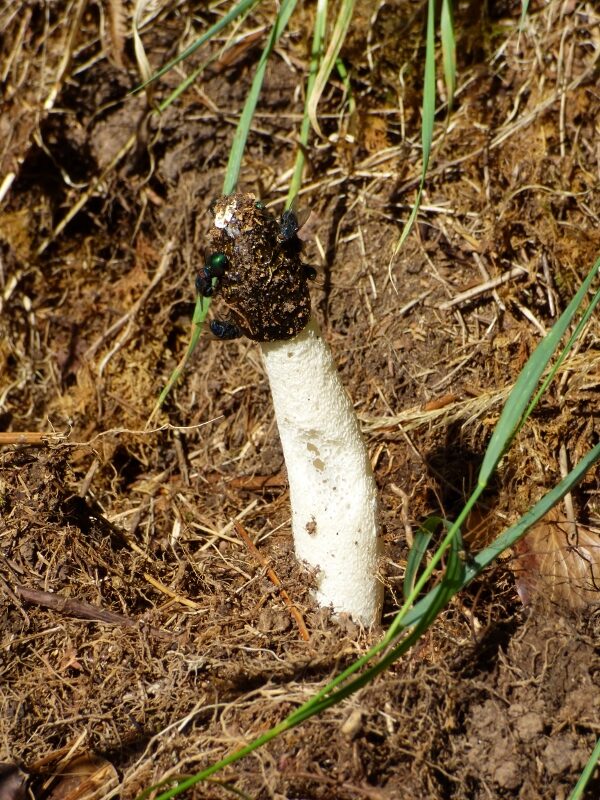
    StinkhornAnd finally The Stinkhorn – which is exactly as it says. If you stroll around, particularly in Badgers Wood, you may occasionally encounter an unpleasant pungent smell.  It is most likely to be the Stinkhorn fungus. Far easier to smell then to see the Stinkhorn usually emerges for just a day or two as a phallic, white stem-like structure with a brown bell-shaped head.  The strong odour attracts flies which then scatter the spores.   Whilst not being keen on the smell we do enjoy trying to hunt these down – dogs may also be attracted but, whilst not considered poisonous, they can certainly cause gastric problems so best avoided.
    And so as autumn begins to show its colours it’s a joy to hear the tentative sounds of the dawn chorus starting up again.  I can’t wait to begin surveying the woods for birds and seeing what turns up during the rest of this year.

  • 18th March 2024

    18th March 2024

    Monday 18th March 2024  9.05 to 9.50 a.m.

    Sitting on a tree stump.

    Many of my birding hours are spent surveying, walking steadily along a regular route listening and looking.  However once in a while it is lovely to just sit as still as possible and wait and see what comes.

    Today, with the much missed blue skies and just the occasional wispy cloud above, after weeks and weeks of rain, I push up through boggy mud to the Limestone Pavement to pick an ash tree stump as my perfect sitting spot.

    With the quarry close by it isn’t long before the Jackdaws make themselves heard.  Like me the Jackdaws are enjoying this moment of warmth and, for them, a chance to enjoy some light thermals in the quarry.  A brief snatch of Peregrine call and the Jackdaws pause but are barely threatened.  They have been sharing the same space for a while now and are accustomed to each other. 

    Below me extends Badgers Wood and I hear loud and clear the song of a Wren deep in the wood – with another responding almost immediately – seemingly as a conversation but more likely as a territory statement. Chiff ChaffThen a Chiff Chaff with it’s distinctive ‘chiff chaff chiff chaff’ song. What a welcome sound that is.  Chiff Chaffs have only just started singing this spring and, for me, it is the bird song that most reflects that winter is nearly over. 

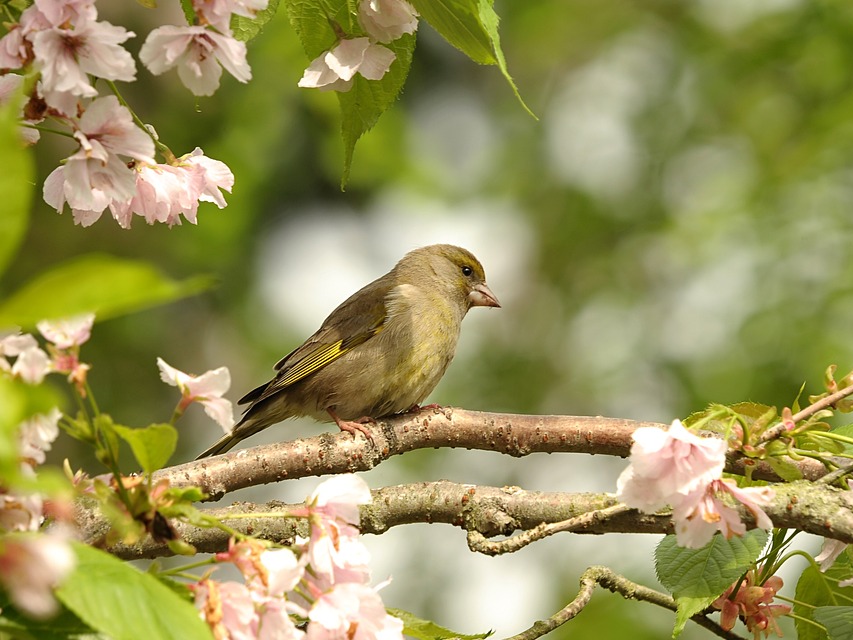
    Next I hear a Green Finch. Green Finch Initially the rasping, wheezing sound of a Green Finch hanging on to the topmost branch of a very tall tree, then the beautiful flute like bubbling sounds of a Green Finch on the move.  Again a bird I am particularly delighted to hear.  The population of Green Finches took a dive during the early 2000s which was linked to an outbreak of trichomonosis and for a while there was real concern for their future.  After 5 years I’d almost forgotten the sound of their song and their distinctive olive green colour with a dash of yellow patches on wings and tail.  Fortunately they are now noticeably increasing in numbers in North Somerset and it is a real pleasure to find them wherever I go.

    As sound continues to rise up from the wood I catch the distant song of a Nuthatch, then a Crow overhead, and a Raven croaking as it passes by. 

    Sadly a drizzle begins and my notepad is soggy so I head back towards the cabin.  As I do the Great Spotted Woodpecker gives a solitary chirp and I begin to hear sounds of Blue Tits and Great Tits amongst the Yew trees.  I have a theory that Tits are late risers.  I rarely seem to hear much of them at the start of a walk but they are often in full busy mode as I head home. 

    As I reach the cabin the rain eases and the birds continue to sing – hardly disturbed by the light change in the weather.


  • Ancient Mining

    Ancient Mining

    The evidence of mining in the past is widely spread across both reserves. The most obvious examples are two 17th century underground lead mines located about 150 metres above the Church Town entrance to JSWNR on the right hand side. (There is a information board situated next to the path).

    leadmines The Remains of one of the Lead Mines Today

    The geology of Jubilee Stone Wood is dominated by Carboniferous limestone which was laid down some 300 to 350 million years ago in a warm, shallow sea from the remains of countless marine animals.

    One hundred and fifty million years later during the Jurassic Period, mineral rich water began to be forced up from the hot depths of the earth through the many faults and fissures in the limestone which today has resulted in the accumulation of numerous metal ores in the bedrock.

    Whilst both copper and iron ores are present in the Carboniferous limestone of Backwell Hill, the most abundant minerals are ‘galena’ (lead sulphide) and ‘calamine’ (zinc carbonate). Historical records confirm that both these metals were being mined here during the 17th century and possibly even earlier as was the case at Goblin Combe. Zinc combined with copper is converted into brass which was a highly prized alloy during the period and was much in demand. In fact during this century, most of the calamine extracted from the west of England originated from this area which, in turn, led to the city of Bristol becoming a major centre for the industry.

    Mining Methods

    The mining of lead in the British Isles goes back to prehistoric times and was one of the factors that attracted the Romans to Britain in 43AD. Lead ore or ‘galena’ usually occurs in narrow, vertically orientated seams. When the miners located these outcrops at or near the surface they would have dug simple, open cast circular pits or grooves to extract the ore.

    Some of the deposits of lead however were found to descend deeper into the bedrock and the miners would have ultimately reached a point where it would become too difficult to remove the rock by shovel whilst the steep walls of the pit would have become increasingly unstable. When this situation developed, the miners would have dug vertically down through the limestone bedrock opening up a small shaft where they could more easily follow the linear seam of galena.

    The ore and waste material was removed from the pit by the use of a hand winch (referred to as a ‘jack roller’ or ‘windlass’) attached to a bucket (known as a ‘kibble’). When the miners reached the bottom of the seam or the limits of practical working they would follow the ore seam on the surface and start a new shaft adjacent to the last, repeating the process as far as it was practical to do so.

  • 12th February 2024

    12th February 2024

    Monday 12th February 2024  9.45 to 11.00 a.m.

    Six weeks into 2024 and, so far, the weather  has chosen to be either super chilly or damp and overcast, with just the occasional day of sunshine to break the gloom.  Today may be mild but it remains cloudy.

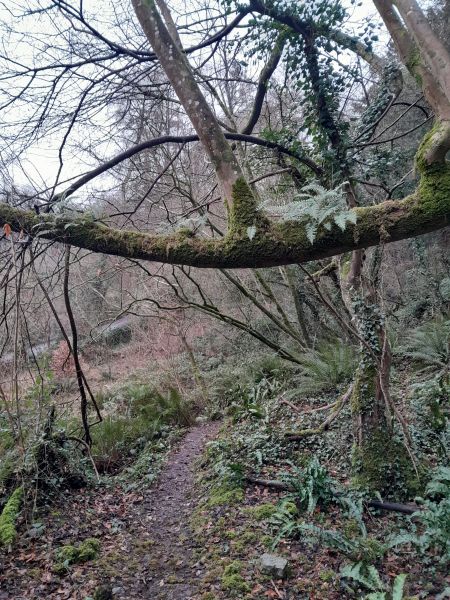
    I enter the woods at the corner of Church Town and Backwell Hill.  The path cuts in to the right of the restored wall and is initially steep and slippery.  But the effort is worth it as the path soon begins to level out, turning right to head down towards the cabin or turning left along the Fern Way. Trees and ferns 600

    The Fern Way is one of the original paths created by BET volunteers through Badgers Wood and is (in my opinion) one of the prettiest.  Fringed either side with ferns of all types, rotting wood (for those, like me, who love a bit of rottenness), a good amount of bramble cover, lichen and fungi it always reminds me of a tropical rain forest.  In fact I suspect it is one!  So rich is it that ferns even grow out of trees. 

    With the overcast conditions keeping sound close to the ground, bird song resonates around the wood.  As I join the Fern Way I can hear the rasp of a Greenfinch, the song of two Robins, a good number of Blue Tits, a Great Tit and the chunter and croak of a Raven overhead.  Even though I am walking quietly, startled Wood Pigeons batter their way out of the nearby trees. 

    The path winds its way up through the middle of Badgers Wood past some incredibly old, knarly and beautiful trees…a couple of which have keeled over revealing a wonderful maze of roots for animals to hide or forage in.  Two thirds of the way up I am pleased to hear the tap tap tap of the Great Spotted Woodpecker. 

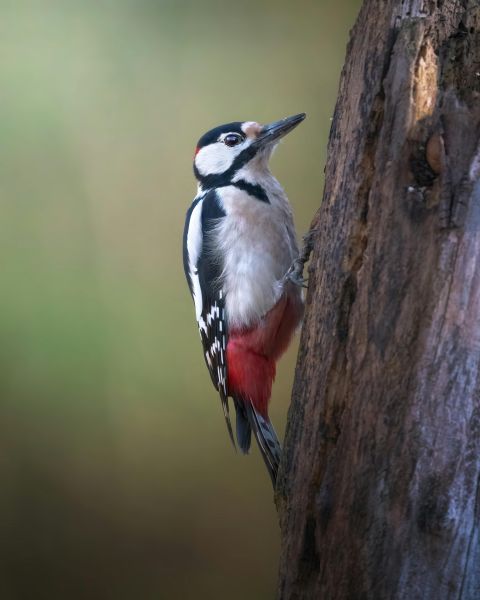
    Great Spotted Woodpecker 600It is rare to spend time in these woods without catching the short, sharp chip of this rather shy bird and the drumming is a nice reminder that spring is on the way.  Great Spotted Woodpeckers, both male and female, drum on trees for communication.  I used to think they were busy making holes for residential purposes but they are actually signalling for a mate or to mark out their territory.  And we appear to have several busy pairs residing in the woods.
    As I approach the top of the Fern Way I pass the stunning Limestone Pavement.  The Pavement is a whole story in itself and is definitely worth a visit.   But my ears are caught by the song of Nuthatch high up in the canopy and then sounds of various bird alarm calls.  Definitely Blackbird and Robin and then, the loudest of all, the Wren.  They buzz and chatter in annoyance – possibly at my presence but more likely at a passing predator or a challenge to their established territory.  

    The path comes up to the quarry and rain begins to fall quite heavily.  Time to cover up and head for home.


  • 6th December 2023 (2)

    6th December 2023 (2)

    Wednesday 6th December  9.00 to 11.00 a.m. Part 2

    The second half of our survey on behalf of the BTO initially takes us off the BET reserve. 

    This is so we can fulfil the requirements of a transect, basically two parallel routes through a chosen square, which helps to avoid double counting.  So we exit the reserve and head for Long Lane and then back along the quarry edge, counting as we go, re-entering the BET reserve at Val’s Gate next to the viewpoint and the quarry in Badgers Wood.

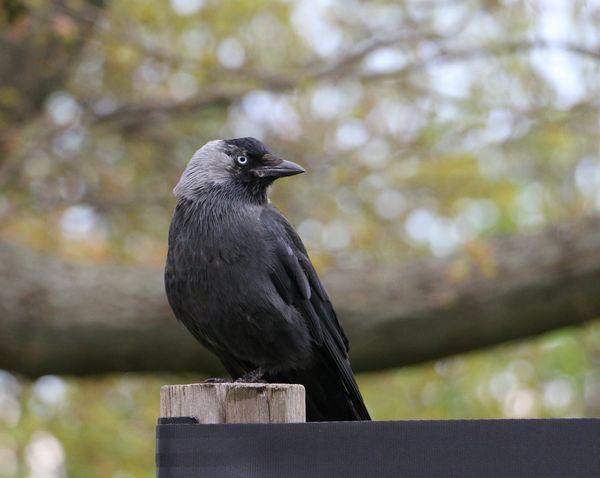
    Jackdaw 600We are immediately greeted by the sound of noisy Jackdaws in, around and above the quarry.  Jackdaws are very intelligent and sociable birds, small and black with a distinctive silvery sheen to the back of the head.  In particularly good numbers in this part of North Somerset it is easy to get used to their urban presence on roof tops and chimneys.  During the day they often move in large flocks, sometimes with other Corvids such as Ravens or Crows.  On the BET reserve their favourite spot is without doubt the quarry.  Easily disturbed from their perch they seem to take real pleasure in the thermals or updrafts.  As usual they are joined by a pair of Ravens who show their status by selecting the best perch on a large tree overlooking the quarry.

    As we circle the quarry we pass Fern Way and catch the sound of a small flock of Goldfinches overhead.  Often heard but not seen on such cloudy days their light twittering passing chatter is cheering. 

    On we go towards the Yew trees.  Here there are fewer birds to see but, because we are high up on the hill and the cloud clover is low, we catch regular snatches of bird sounds from below.  In particular the regular ‘teacher teacher’ of a Great Tit, the trill or more urgent high pitched calls of Blue Tits and the occasional notes of a Nuthatch.
    Goldcrest 4. 600jpg

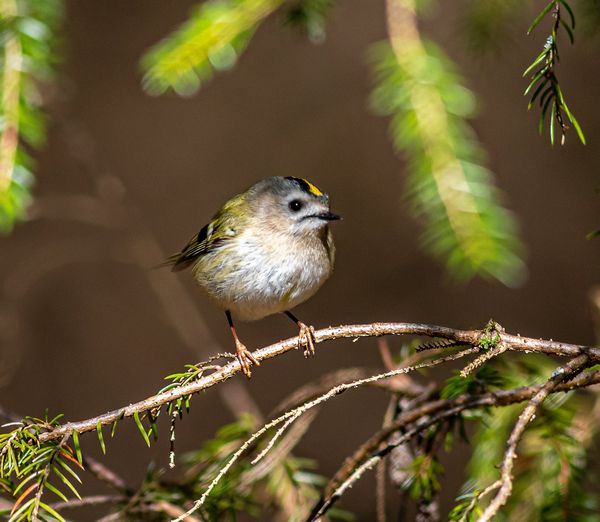
    As we near the end of the Yew tree section we are rewarded with the very high pitch sound of the Goldcrest.  Hard to spot and unusually shy for a Goldcrest we stand still and wait quietly until this one comes into view, foraging busily on the branches.  Goldcrests often move in flocks so perhaps the shyness of this particular bird is due to it being momentarily alone.  As ever, a joy to watch but the grey cloud makes the beautiful colours of the Goldcrest harder to distinguish.

    We leave the Goldcrest to feed and begin our descent noticing that the the bird song is gradually increasing.  At this time of year birds are so often found feeding in and around the local gardens and today is no exception.  Not all of the birds on the reserve will take advantage of the feeders but the Blue Tit, Great Tit, Wood Pigeon and Chaffinch numbers in the woods are surely in part a result of their willingness to move onto feeders in the winter.

    We finish our count at the bottom gate to Badgers Wood.  Despite the cold it is always a joy to walk our regular survey route and to see the progress of life within the woods.  However a hot bowl of soup is top of my list !